The office of the Vice Presidents of Nigeria was established with the inception of the Nigerian Second Republic in 1979. Prior to this, Nigeria had a parliamentary system of government, and during the military regimes, the structure of government did not include a vice presidency in the conventional sense. Instead, roles like the Chief of Staff, Supreme Headquarters were often regarded as second-in-command positions.
The position of Vice President was formally created in 1979 under Nigeria’s first presidential constitution, with Alex Ifeanyichukwu Ekwueme serving as the first Vice President alongside President Shehu Shagari. This marked Nigeria’s shift to a presidential system of government, inspired by the U.S. model, where the Vice President would serve as the second-highest executive officer in the country.
Related: List of Nigeria Past Presidents
Suggested: An Overview of Nigeria Political System
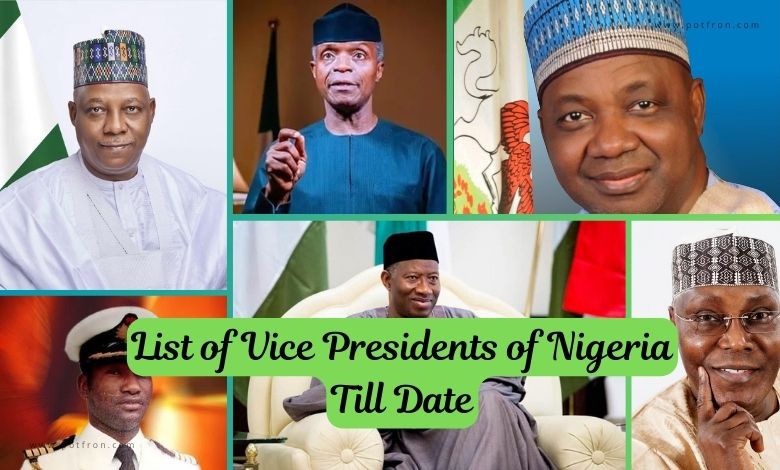
List of Vice Presidents of Nigeria
| Nr. | Vice President Name | VP D.O.B | VP Political Party | VP Assumed Office | VP Left Office | President Served With |
|---|---|---|---|---|---|---|
| 14 | Kashim Shettima | 2 Sept 1966 | APC | May 29, 2023 | Current | Bola Ahmed Tinubu |
| 13 | Yemi Osinbajo | 8 Mar. 1957 | APC | May 29, 2015 | May 29, 2023 | Muhammadu Buhari |
| 12 | Namadi Sambo | 2 Aug. 1954 | PDP | 19 May 2010 | May 29, 2015 | Goodluck Ebele Jonathan |
| 11 | Goodluck Ebele Jonathan | 20 Nov. 1957 | PDP | May 29, 2007 | May 5, 2010 | Umaru Musa Yar Adua |
| 10 | Atiku Abubakar | 25 Nov. 1946 | PDP | May 29, 1999 | May 29, 2007 | Olusegun Aremu Obasanjo |
| 09 | Mike Akhigbe | 29 Sept 1946 | Military | June 9, 1998 | May 29, 1999 | Abdulsalami Abubakar |
| 08 | Lt. General Oladipo Diya | 3 April 1944 | Military | Nov 17, 1993 | June 8, 1998 | Sani Abacha |
| 07 | Augustus Aikhomu | 20 October 1939 | Military | Aug 27, 1985 | Aug 26, 1993 | Ibrahim Babangida |
| 06 | Commodore Ebitu Ukiwe | 26 October 1940 | Military | 27 Aug 1985 | October 1986 | Ibrahim Babangida |
| 05 | Tunde Idiagbon | 14 Sep. 1942 | Military | Dec 31, 1983 | Aug 27. 1985 | Muhammadu Buhari |
| 04 | Alex Ifeanyichukwu Ekwueme | 21 October 1932 | NPN | Oct 1, 1979 | Dec 31, 1983 | Alhaji Shehu Shagari |
| 03 | Shehu Musa Yar’Adua | 5 Mar. 1943 | Military | Feb 13, 1976 | Oct 1, 1979 | Olusegun Aremu Obasanjo |
| 02 | Joseph Edet Akinwale Wey | 6 Mar. 1918 | Military | Aug 1, 1966 | July 29, 1975 | Yakubu Gowon |
| 01 | Babafemi Ogundipe | 6 Sept 1924 | Military | Jan 16, 1966 | July 29, 1966 | Johnson Aguiyi Ironsi |
Related: Nigeria Coat of Arms And its Full Meaning
Related: Nigeria National Anthem and Its Frequently Asked Questions
list of the Vice Presidents of Nigeria who have served in Nigeria since the return to civilian rule in 1999.
| Nr. | VP Name | VP Tenure | President Served Under | Political Party |
|---|---|---|---|---|
| 1 | Alhaji Atiku Abubakar | May 29, 1999 – May 29, 2007 | Olusegun Obasanjo | PDP |
| 2 | Dr. Goodluck Ebele Jonathan | May 29, 2007 – May 5, 2010 | Umaru Musa Yar’Adua | PDP |
| 3 | Architect Namadi Sambo | May 19, 2010 – May 29, 2015 | Goodluck Ebele Jonathan | PDP |
| 4 | Prof. Yemi Osinbajo | May 29, 2015 – May 29, 2023 | Muhammadu Buhari | APC |
| 5 | Senator Kashim Shettima | May 29, 2023 – Present | Bola Ahmed Tinubu | APC |
What are the executive functions of a Nigerian Vice President?
The executive functions of the Vice President of Nigeria are defined primarily by the Constitution of the Federal Republic of Nigeria (1999, as amended) and the delegations of power from the President.
Key Executive Functions of the Nigerian Vice President:
1. Chairing the National Economic Council (NEC):
- The Vice President chairs the NEC, which advises the President on economic affairs.
- The NEC includes all state governors and key federal economic ministers.
- This is arguably the most significant constitutional duty assigned to the Vice President.
2. Acting President (when required):
- Under Section 145 of the Constitution, the Vice President becomes Acting President when:
3. Assisting the President in Execution of Policies:
- The VP supports the President in executing government policies, particularly in areas delegated by the President.
- May oversee specific sectors like the economy, digital innovation, or humanitarian affairs, depending on the administration’s structure.
4. Member of Key Executive Bodies:
- The Vice President is a statutory member of several important councils and committees, including:
- The Federal Executive Council (FEC)
- National Security Council (NSC)
- National Defence Council
- Council of State
5. Diplomatic and Representational Roles:
- Represents the President or the country at diplomatic functions, international summits, and negotiations, when delegated.
6. Supervision of Special Initiatives or Committees:
- The President may assign the Vice President to lead strategic initiatives such as national poverty reduction, investment promotion, or energy reforms.
Who is eligible to be a vice president in Nigeria?
To be eligible to be Vice President of Nigeria, a person must:
- Be a citizen of Nigeria by birth.
- Be at least 35 years old.
- Be a member of a political party and sponsored by that party.
- Have attained at least a School Certificate or its equivalent.
These requirements are outlined in the 1999 Constitution of Nigeria (as amended).
FAQs About Vice Presidents of Nigeria
Vice Presidents of Nigeria